Best Japanese Knives Under $200: The Sweet Spot
Quick Takeaway
- Top pick: Takamura R2 Gyuto 210mm. SG2 powdered steel, impossibly thin grind. The one knife enthusiasts recommend first.
- Best looking: Miyabi Birchwood SG2 Gyuto 200mm. Same SG2 steel, damascus pattern, stunning handle (MSRP has crept above $200).
- Pro kitchen workhorse: MAC Professional Gyuto 200mm. Decades of credibility in commercial kitchens, Seki City.
- Wa handle entry point: Sakai Takayuki 45-Layer Damascus Gyuto 210mm. Traditional Japanese handle without premium prices.
What Changes at This Price
If you have read our guide to the best Japanese knives under $100, you know that budget tier gets you solid VG-10 or AUS-8 stainless with western handles. Good knives. Real Japanese steel. Nothing to apologize for.
Between the low end of this range and the top, three things change in ways you can feel immediately.
Better steel. This is where SG2 (also called R2) powdered steel enters the picture. SG2 is a step up from VG-10 in every measurable way: harder (around 63 HRC versus 60 HRC), finer grain structure, and the ability to take a thinner, keener edge that holds longer. You also start seeing Ginsan (Silver #3) and semi stainless options that blur the line between stainless convenience and carbon steel performance.
Better grinds. At the budget level, factory grinds are consistent but not remarkable. In this range, blade geometry starts to get interesting. Thinner spines, more convex grinds, and profiles that are clearly designed by people who spend their days cutting food. The difference between a good grind and a great grind is the difference between a knife that cuts and a knife that glides.
More choices. Traditional wa handles appear alongside western handles. Kurouchi (forge finished) and nashiji (pear skin) finishes show up next to polished migaki blades. You are no longer limited to one steel type or one handle style. This is where you start picking a knife that matches how you cook, not just what you can afford.
The Picks
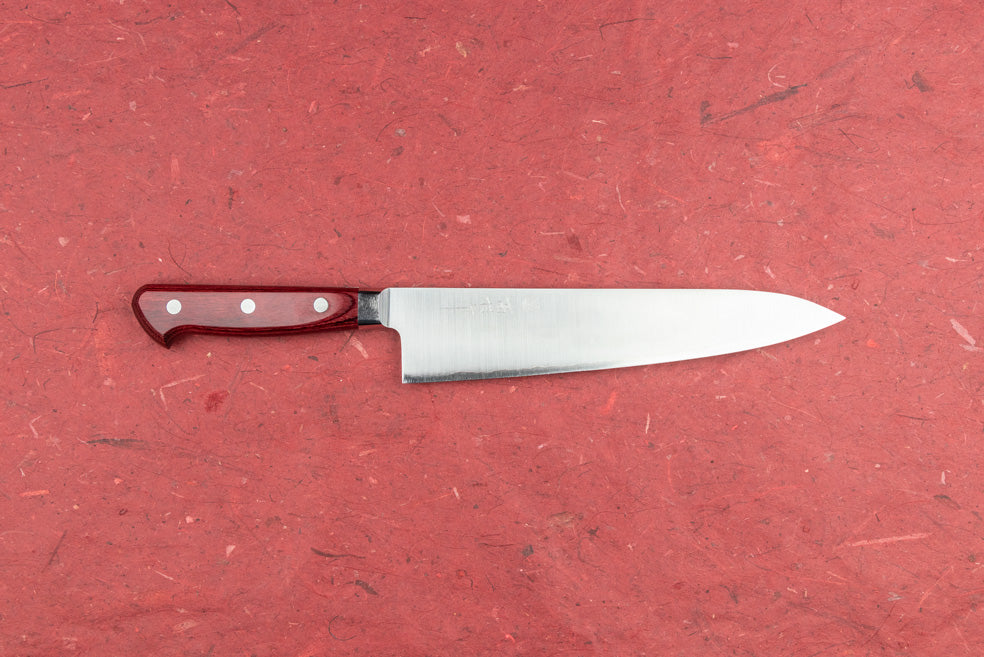
Takamura R2 Gyuto 210mm
Takamura
Takamura R2 Gyuto 210mm
If you spend time on r/chefknives, r/JapaneseKnives, or any knife forum, the Takamura R2 comes up constantly. There is a reason. This knife is what the community calls a “laser,” meaning the blade is ground so thin that it passes through food with almost no resistance.
Takamura makes these in Echizen, Fukui Prefecture, one of Japan’s major knifemaking regions. The steel is SG2 (R2) powdered stainless, hardened to around 63 HRC. That is meaningfully harder than the VG-10 you see in most budget Japanese knives, and it translates directly to a finer, longer lasting edge.
Steel: SG2 / R2 (Powdered Steel) Blade length: 210mm Handle: Western (yo) Finish: Migaki (polished) Hardness: ~63 HRC
The western handle makes this an easy transition for anyone coming from European knives. The blade is thin enough that first time users sometimes find it startling: onions separate before you feel resistance, carrots split cleanly, and herbs get sliced rather than bruised.
The tradeoff is durability. A blade this thin, this hard, will chip if you torque it sideways, hit a bone, or try to rock chop aggressively on a hard surface. Push cutting and pull cutting are where it excels. Treat it like a precision instrument rather than a battering ram.
This knife sits at the very top of the under $200 range. On some retailers it creeps slightly above. But at this price point, SG2 steel with this level of grind work is exceptional.
Who it is for: Cooks who prioritize cutting performance above everything else. Anyone who has used a VG-10 knife and wonders what the next level feels like.
Miyabi Birchwood SG2 Gyuto 200mm
Miyabi
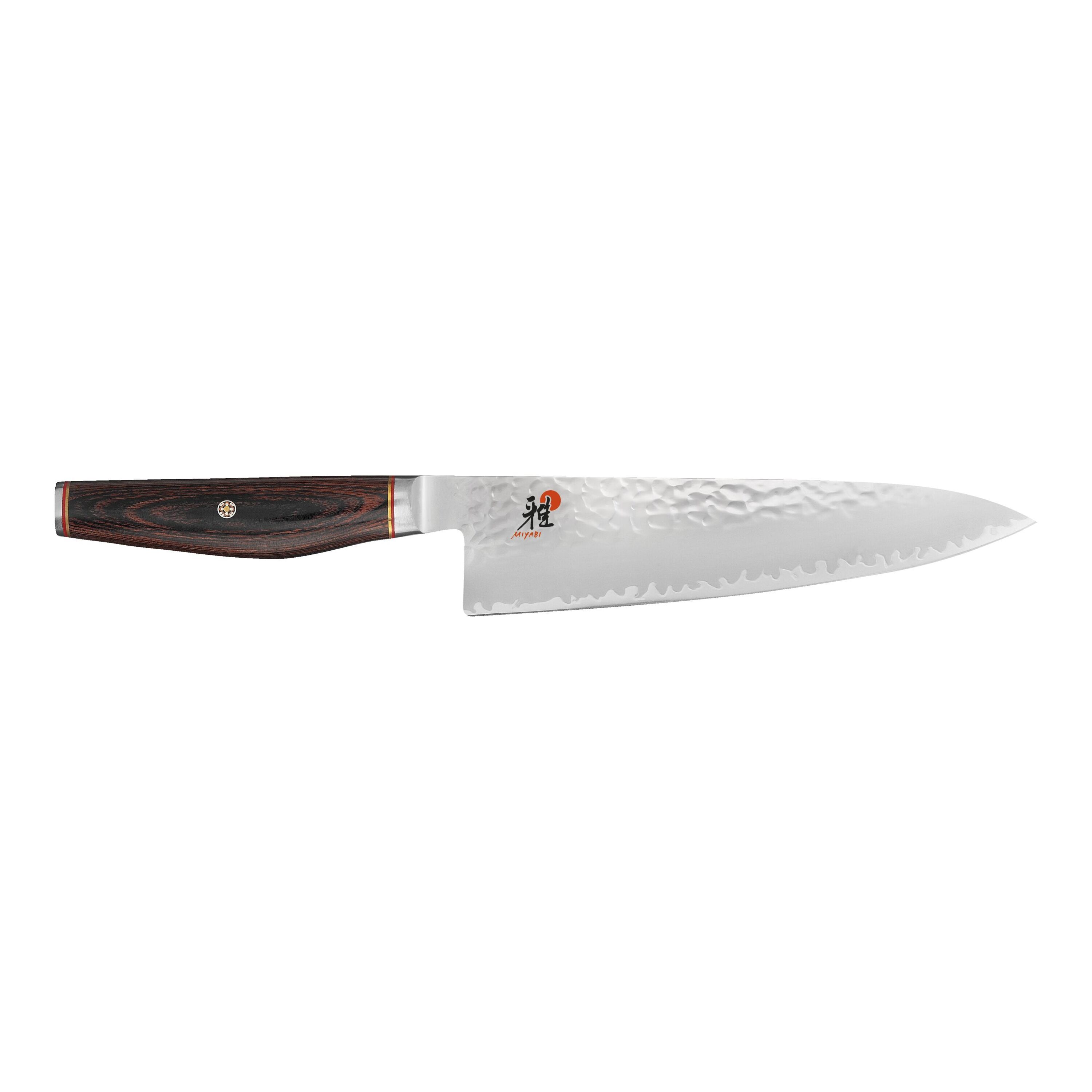
Miyabi Birchwood SG2 Gyuto 200mm
Miyabi is Zwilling’s Japanese knife line, manufactured in Seki City. If the name Zwilling makes you skeptical (a German company making Japanese knives?), the skepticism is fair but misplaced in this case. Miyabi knives are designed and produced entirely in Seki by Japanese craftspeople, and they have earned a strong reputation in both enthusiast and professional communities.
The Birchwood line uses SG2 powdered steel as its core, clad in 101 layers of stainless damascus. The SG2 core gives you the same steel as the Takamura, but the blade geometry is different. Where the Takamura is ground aggressively thin, the Miyabi carries a touch more weight and thickness. It is still thinner than any western knife, but it feels less delicate in hand.
Steel: SG2 / R2 (Powdered Steel), 100 layer damascus cladding Blade length: 200mm Handle: Western (yo), birchwood Finish: Damascus Hardness: ~63 HRC
The handle is one of the best in this price range. The birchwood pakkawood has a warm, natural feel that looks and grips better than the utilitarian handles on most mid range knives. The blade itself, with its layered damascus pattern, is genuinely attractive without relying on flash for its own sake.
A note on pricing: The Miyabi Birchwood’s MSRP has climbed well above this price range in recent years. Zwilling’s current retail price puts it closer to the premium tier. However, it frequently appears at significant discounts during sales events, and authorized retailers sometimes stock it in or near the under $200 range. If you can find it on sale, the value proposition is strong: SG2 steel with damascus cladding and a premium handle. At full retail, consider the Takamura R2 instead for the same core steel at a lower price.
Who it is for: Cooks who want SG2 performance with a bit more heft than a laser. Worth watching for sales if you care about how your tools look.
MAC Professional Gyuto 200mm

MAC
MAC Professional MTH-80 Gyuto 200mm
MAC has been making knives in Seki City since 1964. The Professional line (model MTH-80) is one of the most commonly seen Japanese knives in commercial kitchens, and it shows up in recommendations from professional chefs more often than any knife at twice its price.
MAC uses a molybdenum high carbon stainless steel. They rate their knives between 57 and 61 HRC across lines, with the Professional series sitting at the upper end of that range. That is slightly softer than SG2 but in line with good VG-10 heat treatments. The edge geometry is MAC’s real advantage: thin without being fragile, with a profile that suits both push cutting and a gentle rocking motion.
Steel: MAC proprietary high carbon stainless Blade length: 200mm Handle: Western (yo) Finish: Migaki (polished) Hardness: ~60 to 61 HRC
What makes the MAC Professional special is not any single spec. It is the overall balance. The weight feels right. The handle, while not flashy, is comfortable for long sessions. The blade comes sharp, stays sharp with minimal maintenance, and sharpens easily on a whetstone when it does dull. It is the kind of knife that disappears in your hand and lets you focus on the food.
This is the knife to buy if you care more about performance than specs. It does not win benchmarks. It wins cooking.
Who it is for: Professional cooks or serious home cooks who want a reliable, no nonsense tool. People who have been through the specs obsession phase and just want something that works.
Sakai Takayuki 45-Layer Damascus Gyuto 210mm

Sakai Takayuki
Sakai Takayuki 45-Layer Damascus Gyuto 210mm
Sakai Takayuki is one of the major knife producers in Sakai, the historic knifemaking city near Osaka that has been producing blades for centuries. The 45 Layer Damascus Gyuto is their most accessible entry into traditional Japanese knife construction: VG-10 core, 45 layers of damascus cladding, and a wa (Japanese) handle.
If you have only used western handled knives, the wa handle is worth experiencing. It is lighter, lets the blade’s weight do the work, and gives you a more direct connection to the cutting edge. The octagonal cross section on this model provides a natural grip orientation that many cooks find intuitive once they try it.
Steel: VG-10 (45 layer damascus cladding) Blade length: 210mm Handle: Wa (Japanese, magnolia wood with buffalo horn ferrule) Finish: Damascus Hardness: ~60 HRC
The VG-10 core is the same steel you find in budget knives like the Tojiro DP Gyuto 210mm, but the fit and finish here is a clear step up. The grind is thinner, the edge comes sharper from the factory, and the damascus cladding adds both visual character and functional food release.
This knife sits at the lower to middle portion of this price range, which makes it one of the best values on this list. You get a wa handle, damascus cladding, and Sakai craftsmanship for less than a plain VG-10 knife from some western facing brands.
Who it is for: Cooks curious about wa handles and traditional Japanese construction. Anyone who wants a beautiful knife from a historic knifemaking region without paying boutique prices.
Shun Classic Gyuto 200mm
Shun
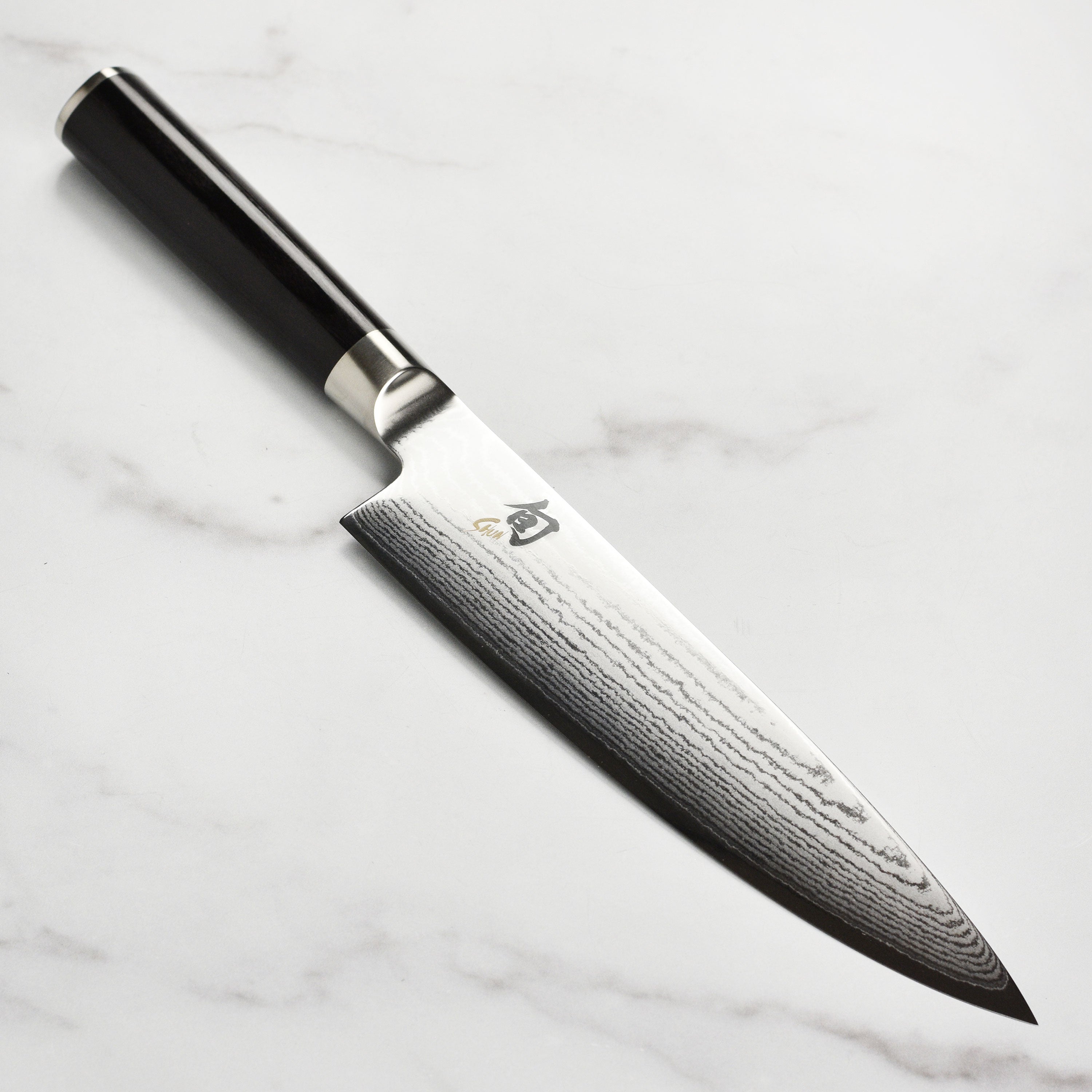
Shun Classic Gyuto 200mm
The Shun Classic is probably the most widely available Japanese knife in the United States. You can find it at Sur La Table, Williams Sonoma, and most kitchen stores that carry premium knives. That ubiquity is both its strength and the source of its mixed reputation in knife communities.
The mixed reputation comes down to price relative to steel. Shun uses VG-MAX, their proprietary steel based on VG-10 with slightly higher carbon and additional trace elements. It performs in the same class as VG-10, which is the same steel family used in the Tojiro DP at a significantly lower price. Enthusiasts look at that and see a markup for branding and retail distribution. That critique has merit if you are comparing spec sheets.
But there are real reasons to consider the Shun Classic. Shun is made by KAI Group in Seki, one of Japan’s biggest and most established knife manufacturers. The damascus cladding gives it visual appeal and food release. The PakkaWood handle is comfortable. And the factory edge is sharp.
Steel: VG-MAX (proprietary, VG-10 family) with damascus cladding (16 layers per side) Blade length: 200mm Handle: Western (yo), PakkaWood Finish: Damascus Hardness: ~60 HRC
The biggest advantage Shun has over everything else on this list: you can hold it before you buy it. Every other knife here requires ordering online from a specialty retailer. If you are the kind of person who needs to feel a knife in your hand before committing, the Shun Classic might be your only option at a physical store. KAI also offers free lifetime sharpening at authorized retailers, which matters for people who do not want to learn whetstones.
Who it is for: Cooks who want to buy from a physical store. Anyone who values warranty support and easy access to sharpening services. Gift buyers who need a premium knife from a recognizable brand.
MAC Superior Santoku 170mm

MAC
MAC Superior Santoku 170mm
Not everyone wants a gyuto. If you prefer the shorter, wider santoku shape, the MAC Superior Santoku is the standout in this range. It is less expensive than the picks above, sitting at the lower end of the mid range, but it consistently outperforms its price class.
We covered this knife in our under $100 guide because it sometimes dips below that line. But for most buyers, it lands firmly in the lower portion of this range. MAC’s molybdenum high carbon stainless steel gives it a thinner, more precise edge than western santoku knives at any price.
Steel: MAC proprietary high carbon stainless Blade length: 170mm Handle: Western (yo) Finish: Migaki (polished)
If you already have a gyuto and want a second knife for shorter, more controlled cuts, or if the santoku shape simply suits your cutting style better, this is the one to get in this range. MAC’s decades of professional kitchen credibility are not an accident.
Who it is for: Santoku fans who want a proven performer. Second knife buyers adding a different shape to their collection.
What We Left Out (and Why)
Masakage Yuki Gyuto 210mm and Yoshikane SKD Gyuto 210mm: The original brief for this article called these out by name, and for good reason. Both are beloved by the knife community: the Masakage Yuki for its Shirogami #2 carbon steel and rustic kurouchi finish, the Yoshikane SKD for its semi stainless steel that sharpens like carbon but resists rust. A few years ago, both sat closer to this price range. Prices have risen significantly, and both now land well above $200 from most retailers. If you can stretch your budget, they deserve a look. But we are not going to recommend them as “under $200” knives when they are not.
Misono UX10 Gyuto 210mm: A legendary knife among professional chefs in Japan, made in Seki with a proprietary Swedish stainless steel. Pricing varies wildly by retailer. Some specialty shops stock it near the top of this range; others price it well above. If you find it under $200, buy it without hesitation. But we cannot guarantee that in the current market.
Tojiro DP Gyuto 210mm: Covered extensively in our under $100 guide. The 210mm model has crept above $100 and now sits at the very bottom of this range. It remains an excellent knife and a smart buy if you want VG-10 performance without spending more. But the knives on this list represent a meaningful step up in grind, steel, or construction.
Global G-2 Gyuto 200mm: A good knife from Global (Yoshikin, Tsubame Sanjo) with its signature all stainless construction. It sits in this price range but the polarizing handle and lighter steel (CROMOVA 18 at ~56 to 58 HRC) make it harder to recommend over the options above. Some cooks love the grip; others find it slippery. Worth handling in person if you can.
How to Choose
Start with the handle. If you have only used western handled knives and want an easy transition, the Takamura R2 Gyuto 210mm, Miyabi Birchwood SG2 Gyuto 200mm, or MAC Professional Gyuto 200mm will feel immediately familiar. If you want to try a traditional Japanese wa handle, the Sakai Takayuki 45-Layer Damascus Gyuto 210mm is the safest entry point. Read more about handle types and what to expect.
Then consider steel. SG2 powdered steel (Takamura, and the Miyabi if you find it on sale) holds an edge longer and takes a finer edge than VG-10 or VG-MAX (Sakai Takayuki, Shun). The tradeoff is that SG2 is harder to sharpen at home if you are new to whetstones. VG-10 and VG-MAX are more forgiving. If you are not yet comfortable sharpening, that matters. Our sharpening guide walks through the basics.
Finally, decide on grind. The Takamura R2 is a laser: maximum cutting performance, minimum durability margin. The MAC and Sakai Takayuki are more forgiving, with a touch more thickness behind the edge. If you are careful with your knives, the laser rewards you. If your kitchen involves some lateral force (scraping, scooping, prying things apart), a slightly thicker grind is more practical.
The Bottom Line
The Takamura R2 Gyuto 210mm is the best performing knife on this list and the one most experienced knife users would pick. If you want cutting performance and already treat your knives with care, start there.
The Miyabi Birchwood SG2 Gyuto 200mm is worth watching for sales: when discounted, it offers SG2 steel with damascus cladding at a competitive price. At full retail it sits above this range, so check current pricing before buying.
And the MAC Professional Gyuto 200mm is the one that professional cooks keep buying. No flash, no gimmicks, just a knife that works every single day.
Any of these will be a clear upgrade from the best knives under $100, and none of them will leave you feeling like you need to spend more. If you are new to Japanese knives entirely, our beginner’s buying guide walks through the basics of what to look for, and our guide on what makes Japanese knives special covers the craft behind the steel. That is what makes this the sweet spot.