Sakai Knives: The 600-Year Tradition Behind Japan's Best Blades
Quick Takeaway
- 90%+ market share: Sakai forged knives are used by an estimated 90% or more of professional chefs in Japan, a claim backed by the Sakai city government and the Sakai Cutlery Industry Association.
- Division of labor: Every knife passes through at least three specialists: the forger (kajishi), the sharpener (togishi), and the handle maker (ezukeshi). Each dedicates their entire career to one discipline.
- 600 years of history: Sakai’s metalworking roots trace to the 5th century Kofun period, with kitchen knife production beginning in the Edo period after tobacco knife makers shifted trades.
- Single bevel is the signature: Sakai is best known for traditional single bevel knives like yanagiba and deba, though modern makers also produce excellent double bevel knives.
- Visiting is worth it: The Sakai Denshokan (Traditional Crafts Museum) is a solid starting point, and several workshops welcome visitors by appointment.
How Sakai Became Japan’s Knife Capital
Sakai sits just south of Osaka, facing Osaka Bay. Today it’s a quiet city of around 820,000 people. But for more than six centuries, it’s been the center of Japanese knife production.
The roots go deeper than knives. Sakai’s metalworking tradition starts in the Kofun period (roughly the 5th century), when blacksmiths gathered in the area to forge iron tools for the construction of Emperor Nintoku’s burial mound. The Nintoku-tenno-ryo Kofun is one of the largest ancient tombs in the world, stretching over 840 meters in total length, and building it required enormous quantities of shovels, hoes, and other iron implements. Smiths were brought in from across Japan to meet demand. Many of them stayed.
Those metalworking skills carried forward. During the Sengoku period (15th to 16th century), Sakai thrived as a free trading city with direct connections to Portuguese and Chinese merchants. When matchlock rifles arrived from Portugal via Tanegashima, Sakai’s blacksmiths quickly mastered production. The city became one of Japan’s primary firearms producers, and Oda Nobunaga is said to have favored Sakai manufactured guns throughout his military campaigns.
From Tobacco Knives to Kitchen Knives
The shift to kitchen knives happened in the Edo period, starting in the early 1600s. As the Tokugawa Shogunate brought peace and firearms demand dropped, Sakai’s smiths needed a new outlet. Around the same time, tobacco cultivation was spreading across Japan after its introduction by Portuguese traders. The tobacco leaves needed to be finely sliced for use, and Sakai’s smiths began producing specialized tobacco cutting knives.
These knives were so sharp and durable that the Tokugawa Shogunate took notice. The government granted Sakai tobacco knives an exclusive quality seal, the “Sakai Kiwame” (堺極) stamp, and sold them as a government endorsed product throughout the country. That seal established Sakai’s reputation for superior blades nationwide.
When tobacco production eventually mechanized, the craftsmen pivoted again. They applied their forging and sharpening expertise to kitchen knives. By the middle Edo period (Genroku era, late 1600s), Sakai smiths had developed most of the kitchen knife types still used today: deba for fish butchery, yanagiba for slicing sashimi, usuba for vegetables. These shapes have remained essentially unchanged for over 300 years.
In 1982, Sakai forged cutlery (堺打刃物) was officially designated as a Traditional Craft by the Japanese government, a recognition that protects and promotes the production methods.
The Division of Labor: Three Specialists, One Knife
What sets Sakai apart from virtually every other knife producing region is the division of labor system. A single knife passes through three separate artisans, each a specialist in one stage of production.
The Kajishi (鍛冶師): The Forger
The kajishi heats selected steel over a charcoal forge and shapes it through repeated hammering and folding. For traditional single bevel knives, this means forge welding a hard carbon steel cutting edge (typically Shirogami or Aogami steel) onto a softer iron body (jigane). The contrast between the hard steel and the soft iron is what gives Sakai knives their characteristic kasumi (mist) finish after sharpening.
The forging process determines the blade’s overall geometry, steel structure, and internal stress patterns. A skilled kajishi adjusts hammer strikes based on the sound, color, and feel of the steel. This isn’t metaphor; experienced forgers can identify steel temperature within a narrow range by observing the color of the heated metal.
The Togishi (研ぎ師): The Sharpener
After forging, the rough blade goes to a completely different workshop. The togishi is responsible for everything from initial grinding to the final cutting edge. This process can involve multiple grindstones, progressing from coarse to extremely fine.
For traditional kasumi finished knives, the togishi creates two distinct visual zones on the blade: the bright, polished hagane (hard steel) edge and the misty, textured jigane (soft iron) body. The transition line between these zones (the shinogi line on single bevel knives) requires real skill to execute cleanly.
The togishi also establishes the blade’s cutting geometry, including the primary bevel angle and the uraoshi (back side concavity) on single bevel knives. Getting this right is critical. A perfectly forged blade with poor sharpening will underperform, and a well sharpened blade from a mediocre forge will still fall short.
The Ezukeshi (柄付師): The Handle Maker
The final specialist attaches and fits the handle. For traditional wa handles, this means shaping magnolia (ho) wood, fitting a buffalo horn ferrule (kakumaki), and burning the tang into the handle for a precise, secure fit. The handle maker adjusts balance and fit so the knife sits comfortably in the hand and the blade tracks straight during cutting.
This sounds simpler than forging or sharpening, but handle fitting directly affects a knife’s usability. A poorly aligned handle makes a knife pull to one side. A loose fit creates wobble. The ezukeshi’s work is what turns a blade into a functional tool.
Why This System Works
The division of labor means each artisan spends an entire career perfecting one discipline. A kajishi who has spent 30 years forging blades develops an intuition for steel behavior that a generalist simply cannot match. The same is true for sharpening and handle fitting.
This is fundamentally different from production regions like Seki, where a single manufacturer typically handles all stages under one roof, or Sanjo, where forging and sharpening are often done by the same craftsman. Sakai’s system trades efficiency for depth of specialization.
The trade off is real, though. Sakai knives take longer to produce and cost more. And because three separate artisans must coordinate, consistency depends on the entire supply chain. A great forger paired with a mediocre sharpener still produces a mediocre knife.
What Makes Sakai Knives Distinctive
Single Bevel Mastery
Sakai’s reputation rests primarily on single bevel (kataba) knives: yanagiba for sashimi, deba for fish butchery, usuba for vegetables. These blade types require the forge welding of two different metals and extremely precise sharpening on one side only. The Sakai Takayuki Kasumi Yanagiba 270mm and Sakai Takayuki Kasumi Deba 165mm represent this tradition well, both forged from Shirogami #2 (White Steel #2) with traditional kasumi finishes.
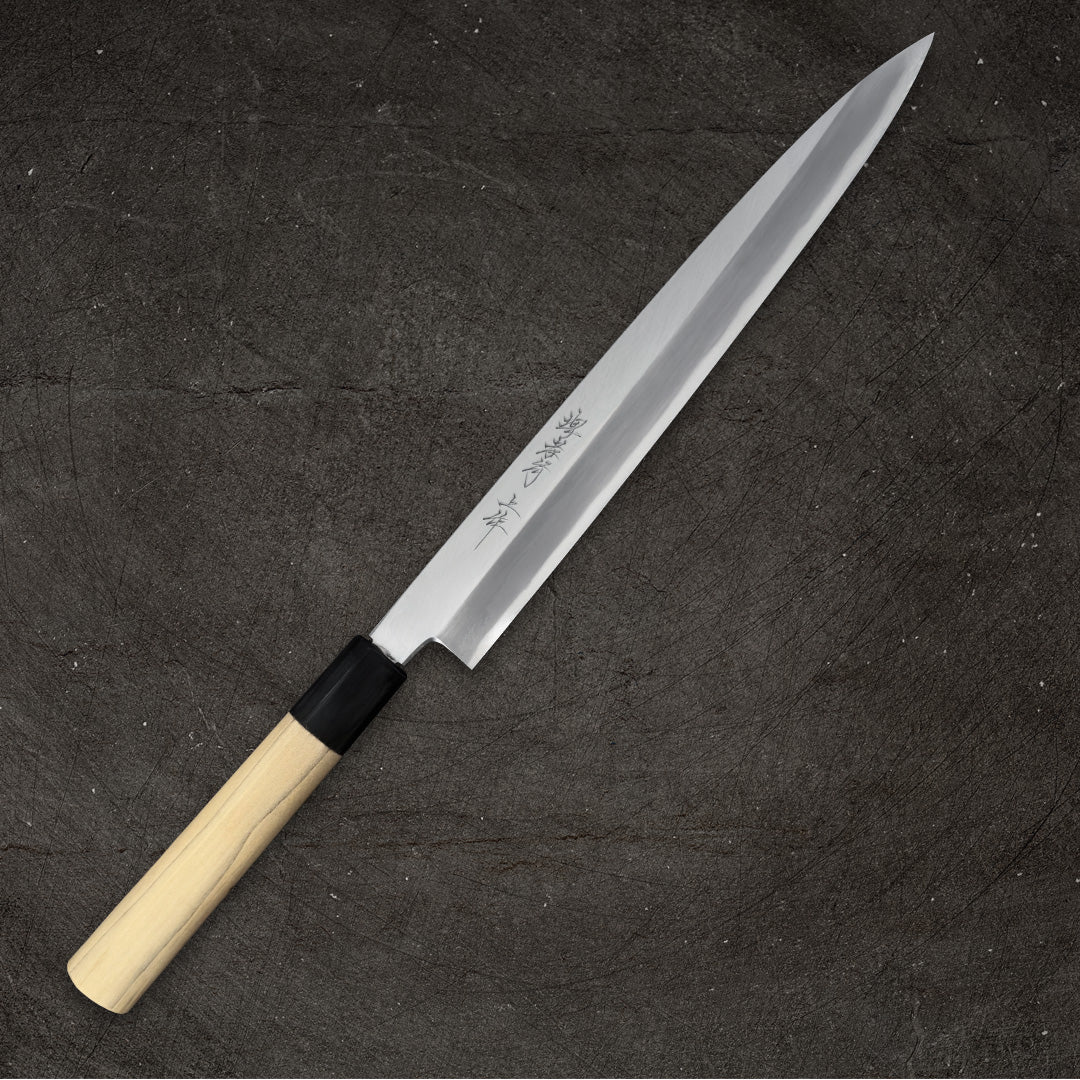

Single bevel knives are the backbone of Japanese professional kitchens. Their asymmetric grind allows for incredibly thin, clean cuts where the flat back of the blade pushes the cut piece away from the edge. For sashimi preparation, this matters. The cleanliness of the cut directly affects texture and visual presentation.
Double Bevel Excellence
Modern Sakai production has expanded well beyond traditional single bevel work. Several Sakai makers now produce outstanding double bevel knives: gyuto, santoku, petty, and sujihiki.
Ashi Ginga is a standout example. The Ashi Ginga Gyuto 210mm, forged by Ashi Hamono in Sakai from Ginsan (Silver #3) stainless steel, has earned a strong following on forums like r/chefknives for its thin grind, light weight, and excellent cutting performance. It’s frequently recommended as one of the best value to performance options from Sakai.

Ashi Ginga
Ashi Ginga Gyuto 210mm
Sakai Takayuki bridges both worlds. Their traditional line covers the full range of single bevel kitchen knives, while their modern lines include Damascus clad double bevel knives like the Sakai Takayuki 45-Layer Damascus Gyuto 210mm (VG-10 core) and Western handled options like the Sakai Takayuki Grand Chef Sujihiki 240mm.

Sakai Takayuki
Sakai Takayuki 45-Layer Damascus Gyuto 210mm

Sakai Takayuki
Sakai Takayuki Grand Chef Sujihiki 240mm
The Kasumi Finish
The kasumi (霞, “mist”) finish is a visual signature of traditional Sakai knives. It results from the contrast between two metals: the hard steel edge and the softer iron cladding. After sharpening, the soft iron develops a matte, misty appearance while the hard steel remains bright and polished. The effect is a natural byproduct of the forge welding and sharpening process, not a decorative treatment, and it has been part of Sakai knife production for centuries.
Notable Sakai Makers and Brands
Sakai has dozens of active workshops, but a handful stand out for quality and reputation. Because of the division of labor system, many “brands” are distributors or brokerages (問屋, tonya) that coordinate between forgers, sharpeners, and handle makers rather than performing all production in house.
Sakai Takayuki (also known as Aoki Hamono) is one of the most recognized Sakai brands globally. They carry a wide product line from entry level stainless knives to high end traditional single bevel work. Their Kasumi and Hongasumi lines are solid representations of traditional Sakai craftsmanship.
Ashi Hamono produces the Ashi Ginga line, which is well regarded in the knife enthusiast community for thin, laser like grinds. Their Ginsan (Silver #3) stainless knives are a frequent recommendation on r/chefknives.
Sakai Ichimonji Mitsuhide is a long established retailer and coordinator that carries knives from multiple Sakai forgers. Their shop in Sakai is a destination for knife buyers visiting the city, and they carry lines from Nakagawa Hamono among others.
Jikko (實光刃物) has been producing knives in Sakai since 1901. They’re known for high end single bevel work and their own retail operation.
Mizuno Tanrenjo is one of Sakai’s most prestigious forging operations, producing hand forged single bevel knives that command premium prices. Their Tanren series, forged from Aogami Super and Shirogami steels, is sought after by professional chefs.
Takada no Hamono operates a small workshop in Sakai. Owner Takada-san is known to be helpful and English friendly with visitors, and produces well regarded single bevel and double bevel knives.
Baba Hamono produces the Kagekiyo line, which Reddit’s r/TrueChefKnives community frequently cites as a top performer from Sakai. They offer various steel options across multiple knife shapes.
Suisin (formerly Suishin) is known for their Inox line, a stainless gyuto that was one of the original “Sakai laser” recommendations on knife forums.
Konosuke produces thin, high performance knives that are popular with enthusiasts. Their HD2 (semi stainless) gyuto has long been a community favorite.
The Masamoto VG Honesuki 150mm is another Sakai produced knife worth noting, a specialized boning knife in VG-10 stainless steel.

Masamoto
Masamoto VG Honesuki 150mm
Sakai vs. Other Japanese Knife Regions
Understanding where Sakai fits relative to Japan’s other knife producing centers helps clarify what makes it distinctive.
Sakai vs. Seki (Gifu): Seki is Japan’s largest knife production center by volume, accounting for roughly 50% of domestic output. Seki excels at consistent, machine assisted production of double bevel stainless knives. Sakai focuses on hand forged production with its three artisan system. If you want a reliable stainless gyuto for home cooking, Seki delivers. If you want a hand forged yanagiba for professional sashimi work, Sakai is the traditional choice.
Sakai vs. Sanjo/Tsubame (Niigata): Sanjo has a strong blacksmithing tradition, but the production model is different. Sanjo smiths tend to be more integrated, handling forging and often sharpening themselves. The region is known for innovative double bevel designs (Global, Tojiro) and tends toward heavier, more robust blade profiles compared to Sakai’s thinner grinds.
Sakai vs. Echizen/Takefu (Fukui): Takefu is home to the Takefu Knife Village cooperative, where individual blacksmiths share facilities. Many popular artisan brands (Yu Kurosaki, Yoshimi Kato, Shigeki Tanaka) forge here. Echizen tends toward more creative, artisan driven production with rustic finishes. Sakai is more traditional and established.
Sakai vs. Tosa (Kochi): Tosa knives are known for their free forging style, heavier profiles, and black finishes. They tend to be more affordable and rustic. Sakai knives, particularly the single bevel lines, involve more refinement and specialization at each production stage.
Visiting Sakai: What to Know
If you’re traveling to the Osaka area and interested in knives, Sakai is an easy day trip. Here’s what’s worth knowing.
Sakai Denshokan (堺伝匠館)
The Sakai Traditional Crafts Museum is the best starting point. Located at 1-1-30 Zaimokucho-Nishi, Sakai-ku, Sakai City, it houses knife displays, demonstrations, and a retail shop with a wide selection of knives across price points. Multi-language staff (Japanese, English, French, Chinese) are available. The museum also covers Sakai’s other traditional crafts: incense, bicycles, and kombu kelp processing.
Open daily except some holidays. Average visit runs 15 minutes to one hour.
Workshops and Shops
Several makers welcome visitors, though appointments are often necessary. Based on community reports from r/TrueChefKnives:
- Sakai Ichimonji Mitsuhide has a retail shop that carries knives from multiple Sakai makers
- Takada no Hamono is a small workshop where you can see production up close
- Jikko has their own retail operation
- Baba Hamono is worth contacting in advance
If you’re visiting with no particular plan, the Denshokan is the safest first stop. Staff there can also point you toward specific workshops based on what you’re looking for.
Getting There
From central Osaka (Namba), take the Nankai Main Line to Sakai Station (about 15 minutes). The knife district and Denshokan are within walking distance of the station.
For more on buying knives during a Japan trip, including shops in Tokyo, Kyoto, and other cities, see our guide to buying knives in Japan.
Who Should Buy a Sakai Knife
Professional chefs working with Japanese cuisine are the core audience for traditional Sakai single bevel knives. If you’re doing sashimi prep, fish butchery, or vegetable work that demands precision cuts, a Sakai yanagiba or deba is the standard tool.
Enthusiasts looking for hand forged quality will find excellent options in Sakai’s double bevel lines. Makers like Ashi Hamono and Konosuke produce gyuto and petty knives that compete with any artisan production from Sanjo or Takefu.
Beginners should be thoughtful. Traditional single bevel knives require specific maintenance knowledge, including proper sharpening technique and understanding of how to maintain the uraoshi. Starting with a Sakai double bevel stainless knife (like the Ashi Ginga line) is a more forgiving entry point than jumping straight to a carbon steel yanagiba.
For more on choosing your first Japanese knife, see our beginner’s buying guide. If you’re comparing knife types, our guide to Japanese knife types covers the full range of shapes and their uses.