Best Kiritsuke Knives: The Multi-Purpose Japanese Blade Explained
Quick Takeaway
- You probably want a k-tip gyuto, not a traditional kiritsuke. If you are searching “best kiritsuke knife,” you are almost certainly looking for a double bevel gyuto with a kiritsuke shaped tip. The traditional single bevel kiritsuke is a specialist professional tool. This guide covers both but focuses on k-tip gyutos.
- Top pick: Shibata Kotetsu SG2 Gyuto 210mm for its laser thin grind, outstanding cutting performance, and the kind of community following that only comes from knives that deliver.
- Premium pick: Yu Kurosaki Senko SG2 Kiritsuke 210mm for SG2 steel, tsuchime finish, and the craftsmanship coming out of Takefu Knife Village.
- Best value: TOJIRO CLASSIC Kiritsuke 210mm F-796 for a no-fuss introduction to the k-tip shape.
- The flat profile matters: Kiritsuke geometry rewards push cutting and tap chopping. If you rock your knife, a gyuto with a curved belly will serve you better.
- Skip the fakes: Brands selling “kiritsuke” knives from Yangjiang, China have flooded online marketplaces. Stick to established Japanese makers.
First: What Are You Looking For?
This is the single most important section in this guide.
When most people search for “kiritsuke,” they are looking at two completely different knives that share a name and a tip shape. Understanding which one you want will save you from a purchase that does not match your expectations.
Traditional Kiritsuke (Single Bevel)
The traditional kiritsuke (切付型) is a single bevel knife, typically 240mm to 300mm, with a flat edge and a distinctive reverse tanto (clipped) tip. It is ground on one side only, like a yanagiba or usuba. This grind allows extremely precise cuts but requires skill to control. The blade naturally drifts to one side during cutting, and sharpening demands single bevel technique.
In traditional Japanese kitchens, only the head chef (板長, itachō) carried one. The kiritsuke combines two specialist knives (the yanagiba for fish slicing and the usuba for vegetable work) into a single blade. Carrying one signaled that you had mastered both disciplines. This was not casual hierarchy. In a professional Japanese kitchen, the knives on a station tell everyone who is working there and what their rank is. A kiritsuke on the station means the head chef is handling something personally.
That tradition still holds weight. In professional settings, carrying a traditional kiritsuke when you are not the head chef is considered presumptuous. It is the knife equivalent of sitting in someone else’s chair.
For home cooks, this tradition does not apply. But it is worth understanding why you rarely see traditional single bevel kiritsuke recommended outside of professional contexts. Very few people need one, and the ones who do already know it.
Kiritsuke Gyuto / K-Tip Gyuto (Double Bevel)
The kiritsuke gyuto (also called “k-tip gyuto” or “kiritsuke style”) borrows only the tip shape from the traditional knife. It uses a double bevel grind, making it as accessible as any gyuto. The angular tip provides excellent precision for detail work, scoring, and creating clean entry points for cuts. Many k-tip gyutos also have a flatter profile than a standard gyuto, which encourages push cutting rather than the rocking motion common with Western chef’s knives.
One nuance worth noting: a k-tip does not guarantee a flat profile, and a flat profile does not require a k-tip. Some k-tip gyutos from makers like Takeda have a continuous curve with no flat spot. Others have a long flat section followed by a gentle rise to the tip. The tip shape and the profile are two separate design choices that often overlap but are not the same thing.
This is the knife most people mean when they search for “kiritsuke,” and it is the focus of our recommendations below.
Our Picks
Top Pick: Shibata Kotetsu SG2 Gyuto 210mm
Shibata Koutetsu
Shibata Kotetsu SG2 Gyuto 210mm
The Shibata Kotetsu has earned its reputation through performance, not marketing. It is one of the most recommended k-tip gyutos in online knife communities, and for good reason. The blade is ground extremely thin, making it an outstanding food separator that glides through vegetables and proteins with minimal resistance. Shibata’s work comes out of Takefu Knife Village in Echizen, and the Kotetsu line represents some of the best laser style grinding in Japanese knife making.
Steel: SG2 / R2 (Powdered Steel) Hardness: ~63 HRC Blade Length: 210mm Handle: Wa, octagonal Grind: Double bevel Finish: Migaki (polished)
The thin grind means this is not a knife for smashing garlic or cutting through chicken bones. It is built for precision cutting where control and a clean edge matter. The SG2 steel gives you strong edge retention with reasonable corrosion resistance. If you want a k-tip gyuto that cuts like nothing else in its class, this is the one the community keeps coming back to.
Premium Pick: Yu Kurosaki Senko SG2 Kiritsuke 210mm
Yu Kurosaki
Yu Kurosaki Senko SG2 Kiritsuke 210mm
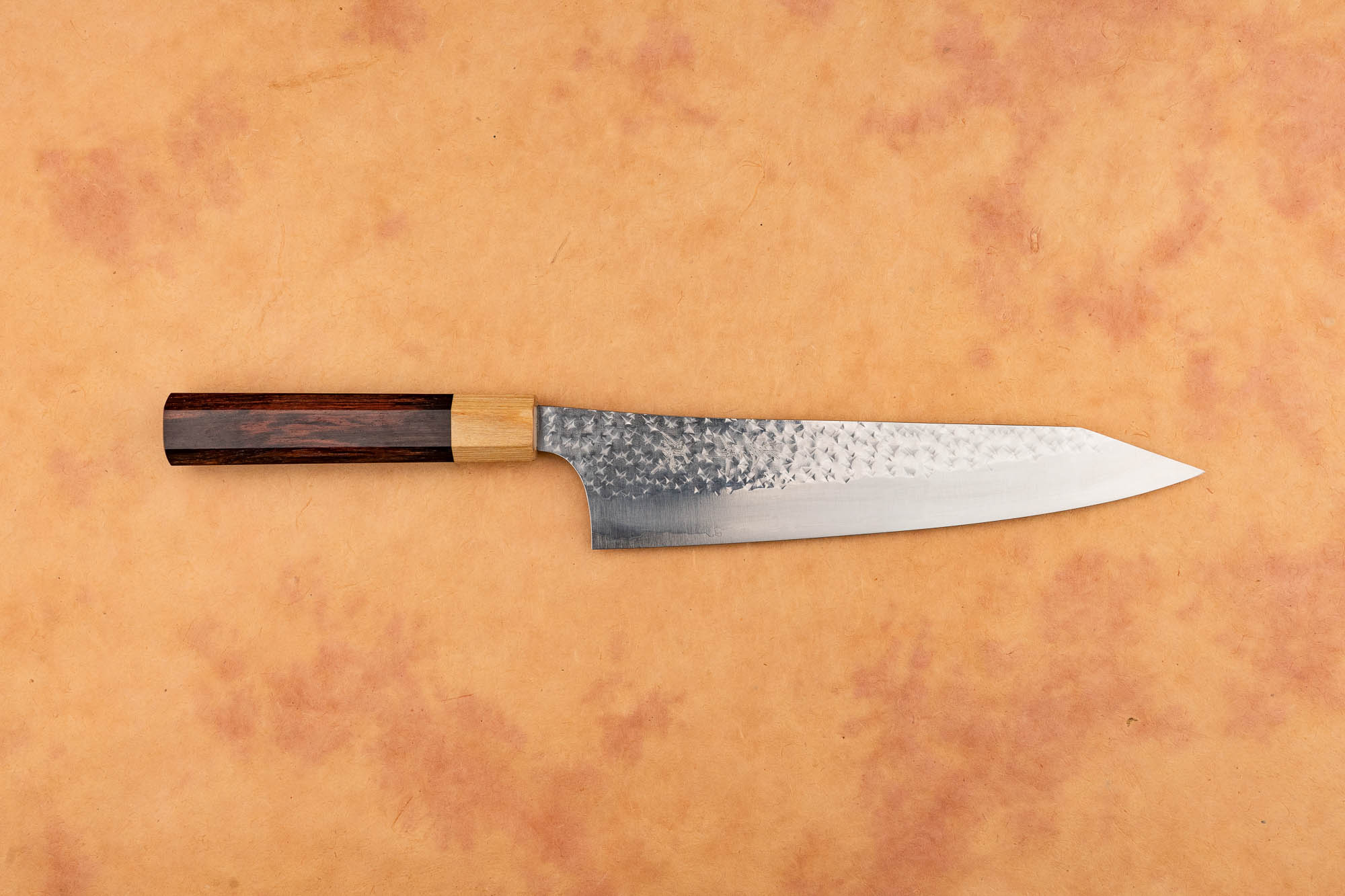
Yu Kurosaki works out of Takefu Knife Village in Echizen, and his knives consistently combine performance with visual appeal. The Senko line uses SG2 (R2) powdered steel at around 63 HRC, giving you strong edge retention with reasonable corrosion resistance. The tsuchime (hammered) finish reduces food sticking and adds visual texture without being purely decorative.
Steel: SG2 / R2 (Powdered Steel) Hardness: ~63 HRC Blade Length: 210mm Handle: Wa, octagonal Grind: Double bevel Finish: Tsuchime
The blade is thin behind the edge with good distal taper, making it a capable food separator. The flat profile is well suited to push cutting through vegetables, and the pointed k-tip gives you precise control for trimming and scoring. Where the Shibata Kotetsu is all about the grind, the Kurosaki Senko adds the tsuchime finish and a slightly more forgiving blade geometry. If you want a k-tip gyuto that performs well and also looks exceptional, this is the pick.
Best Carbon Pick: Hitohira Togashi White #2 Kurouchi Kiritsuke Gyuto 210mm

Hitohira
Hitohira Togashi White #2 Kurouchi Kiritsuke Gyuto 210mm Tagayasan Handle
Hitohira works with individual blacksmiths across Japan, and the Togashi line comes from a smith known for clean carbon steel grinds. This kiritsuke gyuto uses Shirogami #2 (White Steel #2) with a kurouchi (forge scale) finish and a tagayasan (ironwood) wa handle.
Steel: Shirogami #2 Hardness: ~62 to 63 HRC Blade Length: 210mm Handle: Wa, tagayasan Grind: Double bevel Finish: Kurouchi
Shirogami #2 is a pure carbon steel, which means it takes an incredibly keen edge and sharpens with minimal effort. The tradeoff is reactivity: the exposed edge will patina and can rust if left wet. The kurouchi finish protects the blade flats and gives the knife a rustic, forge fresh character. This is a strong pick for cooks who already maintain carbon steel knives and want the satisfaction of a razor sharp edge with easy touch ups on a whetstone.
Best Value: TOJIRO CLASSIC Kiritsuke 210mm

Tojiro
TOJIRO CLASSIC Kiritsuke 210mm F-796
Tojiro in Tsubame-Sanjo has built a reputation for solid performance at accessible prices. The Classic Kiritsuke (formerly DP series) gives you the k-tip profile in a low maintenance stainless package. Tojiro uses VG-10 with stainless cladding in their Classic line, hardened to around 60 to 62 HRC.
Steel: VG-10 Hardness: ~60 to 62 HRC Blade Length: 210mm Handle: Yo (Western, laminated) Region: Tsubame-Sanjo
This is the entry point for anyone curious about the kiritsuke shape. It handles like a standard Tojiro with the flat profile and angular tip that define the style. The Western handle is comfortable for those coming from European knives. If you want to try the k-tip geometry without a significant investment, the Tojiro Classic is a proven starting point. The community recommends it consistently as the place to start before deciding whether to invest more.
Best Value (Carbon): Sakai Ichimonji Blue Steel #2 YOI Kiritsuke-Gyuto 210mm

Sakai Ichimonji Mitsuhide
Blue Steel #2 YOI Kiritsuke-Gyuto
Sakai Ichimonji Mitsuhide (堺一文字光秀) is one of Sakai’s established knife houses, and the YOI line offers genuine Sakai craftsmanship at mid range pricing. This kiritsuke gyuto uses Aogami #2 (Blue Steel #2), a carbon steel with added tungsten and chromium for better edge retention and wear resistance compared to white steel.
Steel: Aogami #2 Blade Length: 210mm Handle: Wa Grind: Double bevel Region: Sakai
Aogami #2 holds an edge longer than Shirogami steels while still sharpening relatively easily. The 210mm length works well for home kitchens, and the double bevel grind makes it approachable for anyone familiar with a gyuto. Buying from Sakai Ichimonji means you are getting a knife made in one of Japan’s most storied knife production regions, with the traditional three craftsman process (forger, sharpener, handle maker) that defines Sakai’s knife heritage.
Longer Option: Konosuke GS+ Kiritsuke Gyuto 240mm

Konosuke
Konosuke GS+ Kiritsuke Gyuto 240mm Walnut Handle
Konosuke has built a dedicated following among knife enthusiasts for their thin, precise grinds. The GS+ line uses a proprietary stainless steel developed for their specifications. The 240mm kiritsuke gyuto gives you a longer flat edge for draw cuts and better reach across large vegetables, with the kind of behind the edge thinness that makes ingredients fall away from the blade.
Steel: GS+ (proprietary stainless) Blade Length: 240mm Handle: Wa, walnut Grind: Double bevel
Konosuke’s GS+ steel is a low-chromium stainless that sharpens more easily than typical stainless options. It rewards proper stone work and takes a fine edge. The 240mm length is ideal for cooks who want the extended flat profile that makes kiritsuke geometry shine, whether you are working through a whole cabbage or making long draw cuts through proteins. This is a step up in both price and performance from the 210mm picks above.
Hidden Gem: Tsunehisa Ginsan Migaki Oak Kiritsuke 240mm

Tsunehisa
Tsunehisa Ginsan Migaki Oak Kiritsuke 240mm
Tsunehisa produces knives that tend to fly under the radar relative to their quality. This 240mm kiritsuke uses Ginsan (Silver Steel #3), a stainless steel made by Proterial (formerly Hitachi Metals) that sharpens almost as easily as carbon steel while resisting corrosion.
Steel: Ginsan (Silver Steel #3) Blade Length: 240mm Handle: Wa, oak Grind: Double bevel Finish: Migaki (polished)
Ginsan is an underappreciated steel that behaves like carbon on the stones but forgives the occasional forgotten wipe. The migaki finish is clean and professional. This is a strong choice for cooks who want a longer kiritsuke without the maintenance demands of reactive carbon steel, at a lower price point than the Konosuke.
Traditional Single Bevel Picks
For those interested in the traditional single bevel kiritsuke, these are serious professional tools. If you are not already experienced with single bevel knives and comfortable sharpening them, start with a k-tip gyuto instead.
Sakai Ichimonji Mitsuhide produces both the Blue Steel #2 Hongasumi Kiritsuke 240mm in Aogami #2 and the White Steel #1 Montanren Kiritsuke Yanagiba 240mm in Shirogami #1. These are made in Sakai using the traditional division of labor between forger, sharpener, and handle maker.
Hitohira Togashi White #1 Kiritsuke Yanagiba 300mm is a 300mm professional length option for those who need the reach for sashimi work and vegetable prep at scale.
Also Worth Knowing
Several other kiritsuke gyuto models did not make our top picks but are worth noting:
Yoshimi Kato Kiritsuke Gyuto 240mm comes from one of Echizen’s respected blacksmiths. Kato’s work is well regarded among knife enthusiasts, and the 240mm length gives you a strong working platform.
Sukenari ZDP189 Migaki Kiritsuke Gyuto 210mm uses ZDP-189, which delivers exceptional edge retention (64 to 67 HRC) but is notably harder to sharpen than SG2 or carbon steels. A strong knife for experienced sharpeners who prioritize longevity between sessions.
Moritaka Ishime Kiritsuke 240mm comes from a Tosa based forge in Kochi Prefecture, a region with roughly 400 years of blacksmithing tradition dating to the early Edo period. Moritaka’s ishime (stone pattern) finish is distinctive, and their knives are known for aggressive, thin grinds.
Tadafusa Nashiji Blue #2 Kiritsuke 210mm Walnut Handle from Sanjo brings Aogami #2 with a nashiji (pear skin) finish and walnut handle at an accessible price.
How to Choose Your Kiritsuke
If you want the best cutting performance: The Shibata Kotetsu’s laser thin grind is hard to beat. It is purpose built to slice through food with minimal resistance.
If you want performance plus aesthetics: The Yu Kurosaki Senko gives you excellent cutting performance alongside a tsuchime finish that looks as good as it works.
If you want low maintenance: Go with SG2 (Shibata Kotetsu or Yu Kurosaki Senko) or Ginsan (Tsunehisa). Both resist corrosion and hold excellent edges.
If you want the sharpest possible edge: Carbon steels like Shirogami #2 (Hitohira Togashi) or Aogami #2 (Sakai Ichimonji YOI) take keener edges than stainless options. You will need to dry the blade after each use and develop a patina over time.
If you are trying the shape for the first time: Start with the Tojiro Classic at 210mm. It is affordable enough that you can test whether the flat profile and k-tip geometry suit your cutting style before investing more.
210mm vs 240mm: The 210mm size handles like a standard gyuto and fits most cutting boards comfortably. The 240mm gives you a longer flat edge for draw cuts and better reach across large vegetables, but requires more board space and confidence with a longer blade. The kiritsuke shape benefits from length more than most knife types because that flat edge is where the geometry shines.
Cutting technique matters. Kiritsuke geometry rewards push cutting and tap chopping. The flat profile means there is minimal belly for rock chopping. If rocking is your primary technique, a gyuto with a curved profile (see our best gyuto knives guide) will work better for you.
A Note on Fake “Kiritsuke” Knives
Online marketplaces are flooded with knives labeled “kiritsuke” from brands like Dalstrong, XINZUO, and various Amazon house brands. These are manufactured in Yangjiang, China and have no connection to Japanese knife making traditions. They typically use lower grade steels with inflated hardness claims and aggressive marketing. Our authenticity guide covers how to spot these in detail. Every knife recommended in this article is made in Japan by an established Japanese maker.
FAQ
What is the difference between a kiritsuke and a kiritsuke gyuto?
A traditional kiritsuke is a single bevel knife that combines the functions of a yanagiba (sashimi slicer) and usuba (vegetable knife). A kiritsuke gyuto is a double bevel knife with only the k-tip shape borrowed from the original. The kiritsuke gyuto works like a regular gyuto with a flat profile and reverse tanto tip, making it far more accessible to home cooks.
Is a kiritsuke good for beginners?
A kiritsuke gyuto (double bevel) is suitable for anyone comfortable with a gyuto or santoku. The flat profile encourages push cutting rather than rocking. A traditional single bevel kiritsuke is not recommended for beginners because it requires experience with single bevel sharpening and specific cutting techniques.
What size kiritsuke should I get?
For a kiritsuke gyuto, 210mm is the most versatile size and works well for most home kitchens. If you have board space and want more slicing capability, 240mm gives you a longer draw cut. Traditional single bevel kiritsuke knives typically start at 240mm and go up to 300mm or longer.
Can I use a kiritsuke as my main kitchen knife?
A kiritsuke gyuto can absolutely serve as a primary knife. It handles the same tasks as a gyuto with a slightly different geometry. The flat profile excels at push cutting vegetables and proteins. The pointed tip gives precise control for detail work. Many cooks use a kiritsuke gyuto as their daily driver.
Why is the kiritsuke considered a head chef’s knife?
In traditional Japanese kitchens, the single bevel kiritsuke was reserved for the head chef (板長, itachō) because it combines two specialist knives into one. Using it demonstrated mastery of both yanagiba and usuba techniques. This status tradition does not apply to modern double bevel kiritsuke gyuto knives, which anyone can use.