Seki Knives: The Blade Capital Behind Japan's Biggest Knife Brands
Quick Takeaway
- Half of Japan’s knives: Seki City accounts for roughly 50% of domestic knife production in Japan, making it the country’s largest knife manufacturing center by volume.
- 800 years of blades: Swordsmiths arrived in the Kamakura period, drawn by clean water, quality clay, and abundant pine charcoal. The tradition never stopped.
- Home to the big names: Shun, MAC, Misono, Miyabi, Seki Magoroku, Fujiwara FKM, and Seki Kanetsune all manufacture here. If you’ve used a Japanese knife, there’s a good chance it came from Seki.
- Modern production model: Unlike Sakai’s hand forged, three artisan system, Seki blends traditional techniques with modern manufacturing. The result is consistent quality at scale.
- Worth visiting: The annual Seki Cutlery Festival (October), Seki Terrace, the Traditional Swordsmith Museum, and the Feather Museum make Seki a rewarding day trip from Nagoya.
From Samurai Swords to Kitchen Knives
Seki City sits in the heart of Gifu Prefecture, about an hour north of Nagoya. Today it’s a manufacturing hub, one of the world’s three major cutlery producing regions alongside Solingen, Germany and Sheffield, England. But the story starts with swords.
Swordsmiths began settling in Seki during the late Kamakura period (late 1200s). The area offered ideal conditions for forging: clean water from the Nagara River and Tsubo River for quenching, high quality yakiba tsuchi (clay) for differential hardening, and plentiful pine charcoal for fuel. Two smiths, Motoshige and Kaneshige, are traditionally credited as the founders of Seki’s blade making tradition.
By the Muromachi period (1336 to 1573), Seki had become one of Japan’s premier sword producing centers. The swords were known for their practical qualities: they cut well, resisted bending, and held up under hard use. These were battlefield weapons first, and samurai across Japan sought out Seki blades for their reliability.
The smiths developed a distinctive forging approach as part of what became known as Mino-den (美濃伝), one of the five major sword making traditions of Japan (Gokaden). It emphasized a balance between hardness and toughness, using local iron sand, water, clay, and pine charcoal in a process that remains essentially unchanged today. At its peak, Seki had over 300 swordsmiths working in the area.
The Transition to Cutlery
When the Meiji Restoration ended the samurai era in 1868, demand for swords collapsed. Seki’s smiths, like blade makers across Japan, had to adapt. Unlike Sakai, which had already pivoted to kitchen knives centuries earlier through tobacco knife production, Seki’s transition happened in the modern era.
The shift to cutlery production accelerated in the late 19th and early 20th centuries. Seki’s smiths began applying their metallurgical knowledge to kitchen knives, scissors, razors, and pocket knives. The city’s strategic location (central Japan, good rail connections to Nagoya and beyond) helped it scale production in ways that smaller, more remote knife regions could not.
A pivotal moment came in 1908, when Saijiro Endo founded what would become the KAI Group, starting with pocket knife production. Other manufacturers followed. By the mid 20th century, Seki had transformed from a sword town into an industrial cutlery powerhouse.
Today, Seki produces roughly 50% of all knives manufactured in Japan. The city hosts around 60 member companies in the Seki Cutlery Association, plus additional independent operations. Production spans kitchen knives, scissors, nail clippers, razors, medical instruments, and industrial cutting tools.
How Seki Knives Are Made
Seki’s production model is fundamentally different from regions like Sakai or Sanjo.
In Sakai, a single knife passes through three separate artisans (forger, sharpener, handle maker), each spending an entire career mastering one discipline. In Sanjo, individual blacksmiths often handle forging and sharpening personally. Seki operates differently: most production happens within integrated factories where forging, grinding, sharpening, assembly, and quality control all occur under one roof.
This doesn’t mean Seki knives are purely machine made. The better manufacturers use a blend of automation and hand finishing. Steel blanking, rough grinding, and heat treatment are typically mechanized for consistency. But edge sharpening, final inspection, and quality control often involve skilled technicians. Miyabi, for example, uses what Zwilling calls their honbazuke process, a multi step hand sharpening technique that produces edge angles as acute as 9.5 to 12 degrees per side.
The advantage of Seki’s model is consistency and scale. A Shun Classic or a MAC Professional knife from Seki will perform very similarly from one unit to the next. In hand forged production regions, individual variation is inherent (and often prized), but consistency across thousands of units is harder to achieve.
The trade off is that Seki knives generally lack the individuality of hand forged work. A Sakai yanagiba or a Sanjo blacksmith’s gyuto carries marks of the specific craftsman who made it. Seki knives tend toward clean, uniform aesthetics.
Steel and Heat Treatment
Seki manufacturers work across the full range of Japanese knife steels. The most common grades seen in Seki produced knives include:
VG-10 and VG-MAX: The workhorse stainless steels. VG-10 (produced by Takefu Special Steel in Echizen) is used extensively by Shun, Seki Magoroku, and others. VG-MAX is KAI Group’s proprietary variant with slightly higher carbon content. Typical hardness: 60 to 61 HRC.
SG2/R2: Powdered stainless steel from Takefu Special Steel. Used in Miyabi’s premium Birchwood line and several higher end Seki productions. Allows hardness up to 63 to 64 HRC while maintaining stainless properties.
AUS-8 and Molybdenum Stainless: Budget to mid range stainless steels. Fujiwara FKM uses AUS-8, and MAC uses proprietary molybdenum vanadium stainless across their lines.
Swedish Stainless: Misono’s UX10 line uses imported Swedish stainless steel, setting it apart from most Seki production.
DSR-1K6: A proprietary stainless steel used by Seki Kanetsune, known for good edge retention at a budget price point.
The Major Seki Brands
Seki is home to some of the most recognized names in the Japanese knife world. Here’s what each brings to the table.
KAI Group (Shun and Seki Magoroku)
Founded in 1908 by Saijiro Endo as a pocket knife manufacturer, the KAI Group is now one of the world’s largest cutlery companies. They operate two major kitchen knife brands from Seki.
Shun is KAI’s premium export line. The Shun Classic series uses VG-MAX steel clad in Damascus pattern layers, with distinctive D-shaped ebony PakkaWood handles. It’s the most widely recognized Japanese knife brand in Western retail and has introduced millions of home cooks to Japanese knives. The Shun Classic Nakiri 165mm is a good example of what the line does well: clean Damascus aesthetics, sharp out of the box, and a comfortable handle. The knife community on Reddit tends to be divided on Shun: praised for build quality and accessibility, criticized for being overpriced relative to what specialists like Takamura or Yoshikane offer at similar price points.
Seki Magoroku is KAI’s domestic Japanese brand, named after the legendary swordsmith Kanefusa. The line runs from budget home knives all the way to professional grade carbon steel. The Seki Magoroku 10000CL Gyuto 210mm uses VG-10 steel and competes directly with dedicated mid range knife makers.

Seki Magoroku
Seki Magoroku 10000CL Gyuto 210mm
MAC
MAC was founded in 1964 in Seki and has built a strong reputation for producing sharp, lightweight knives that perform above their price tier. MAC uses proprietary high carbon molybdenum vanadium stainless steel and grinds their blades thin. The MAC MTH-80 Professional Gyuto 200mm is one of the most frequently recommended knives on r/chefknives for cooks who want a no nonsense performer without paying premium prices.

MAC
MAC Professional MTH-80 Gyuto 200mm
MAC’s approach is straightforward: simple handles, thin grinds, aggressive factory edges. They don’t do Damascus cladding, elaborate finishes, or premium handle materials. The focus is entirely on cutting performance. Serious Eats has consistently ranked MAC knives among their top picks.
Misono
Founded in 1935, Misono is a family run manufacturer that specializes in Western style (yo handle) kitchen knives. Their UX10 series, which uses Swedish stainless steel, is a staple in professional kitchens across Japan and worldwide. The Misono UX10 Gyuto 210mm is known for its thin, clean grind and comfortable handle.
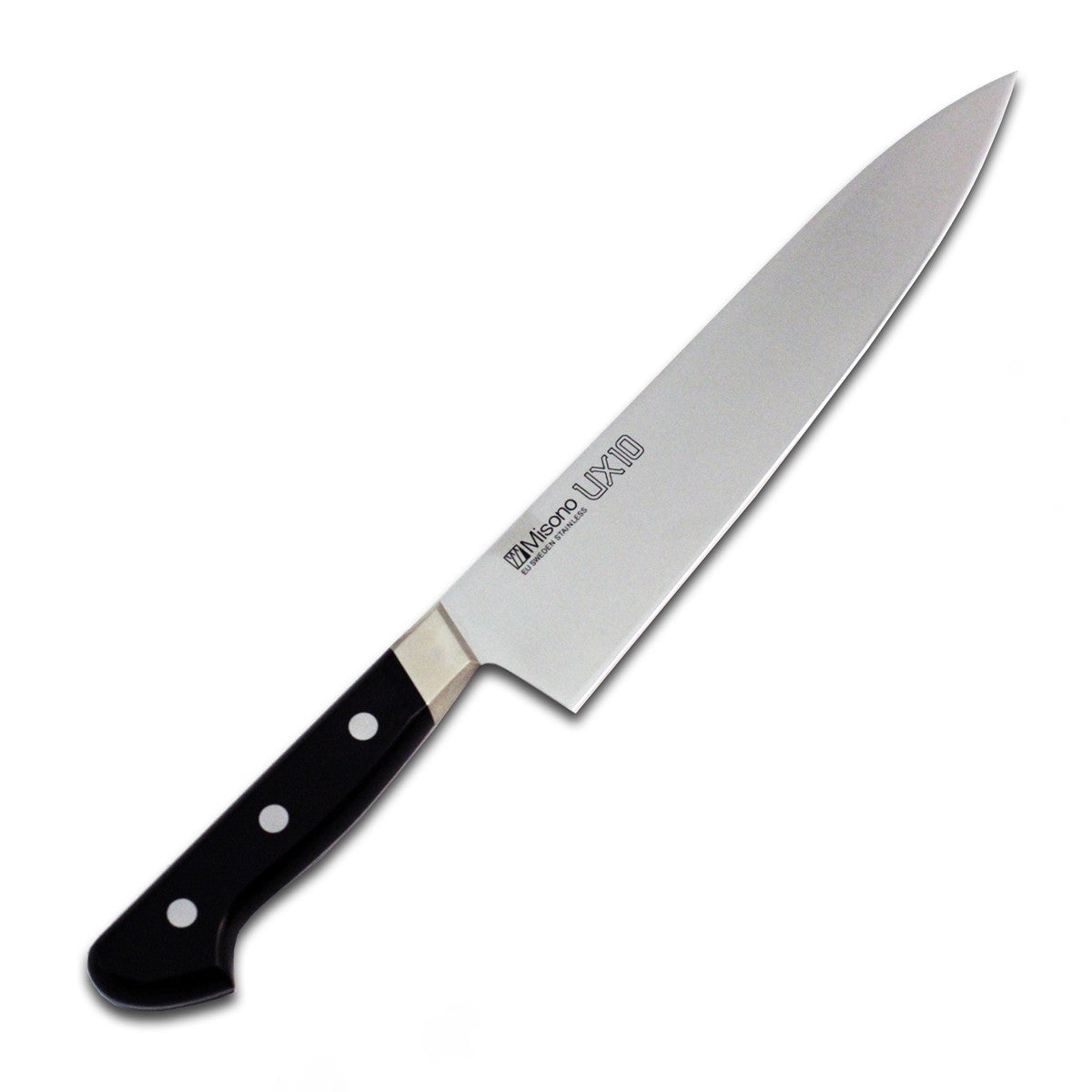
Misono
Misono UX10 Gyuto 210mm
Misono sits in a category of its own among Seki brands. While most Seki manufacturers have embraced some level of mass production, Misono maintains a smaller, more hands on operation. Their knives carry a premium, but the fit and finish are noticeably refined compared to mass market alternatives.
Miyabi (Zwilling)
Miyabi is Zwilling J.A. Henckels’ Japanese knife line, manufactured in their Seki factory by Japanese craftsmen. The brand is genuinely made in Japan, but owned and directed by a German company. This creates an unusual position: the knives benefit from Seki’s production expertise and Japanese steel, but the design sensibility and marketing come from a European perspective.
The Miyabi Birchwood SG2 Bunka 160mm showcases what this combination produces: SG2 powdered steel hardened to 63 HRC via Zwilling’s CRYODUR ice hardening process, 101 layers of Damascus cladding, and a honbazuke hand sharpened edge. The fit and finish are exceptional.
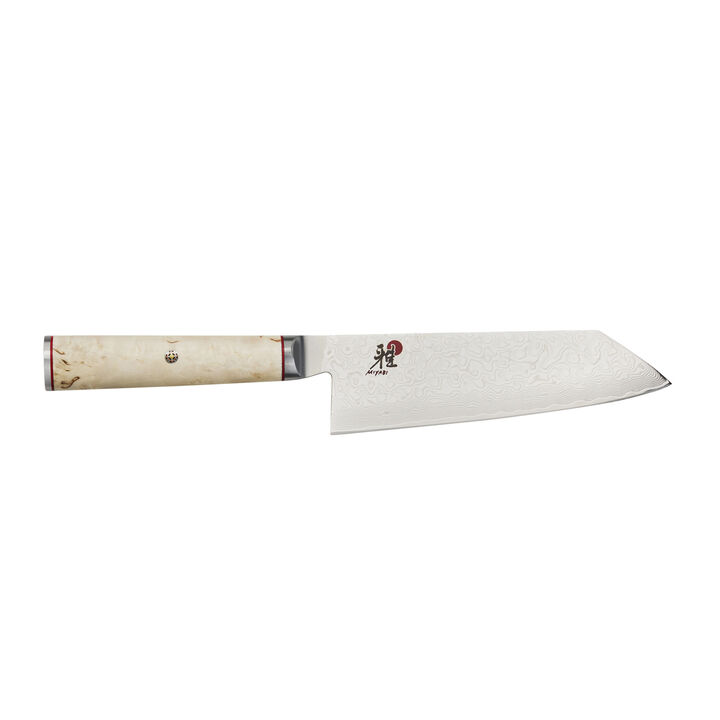
Miyabi
Miyabi Birchwood SG2 Bunka 160mm
The knife community tends to view Miyabi as a legitimate but expensive option. The knives perform well, but you’re paying a premium for the Zwilling brand infrastructure. At similar price points, smaller artisan makers from Echizen or Sanjo may offer more steel for the money.
Fujiwara FKM
Fujiwara FKM (now rebranded as SOUMA) is the budget entry point for Seki production. The Fujiwara FKM Gyuto 210mm uses AUS-8 stainless steel at around 58 HRC and is one of the most recommended beginner knives on r/chefknives. It’s thin, cuts well, and costs a fraction of what most Japanese knives command.
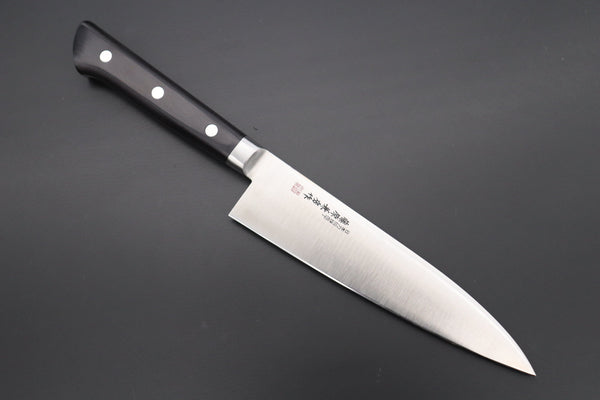
Fujiwara FKM
Fujiwara FKM Gyuto 210mm
The FKM line doesn’t pretend to be anything it isn’t. Simple plastic handle, basic fit and finish, no fancy cladding. What it does offer is a well ground blade from a real Seki manufacturer at a price point that makes Japanese knives accessible.
Seki Kanetsune
Seki Kanetsune (Kitasho Co., Ltd.) was established in 1964 and produces both kitchen knives and outdoor knives. The Seki Kanetsune 1K6 Hammered Gyuto 210mm uses DSR-1K6 stainless steel with a tsuchime (hammered) finish, offering a more artisan aesthetic at a budget price point.
Seki Kanetsune
Seki Kanetsune 1K6 Hammered Gyuto 210mm
Feather Safety Razor
Not a knife company, but worth mentioning: Feather Safety Razor Co. is headquartered in Seki and is the world’s leading manufacturer of surgical blades and safety razor blades. Feather blades are used in operating rooms globally and are prized by wet shaving enthusiasts for their extreme sharpness. The company exemplifies how Seki’s blade making tradition extends well beyond kitchen knives.
Beyond Kitchen Knives
Seki’s cutlery industry encompasses far more than what you’d find in a kitchen. The city’s manufacturers produce:
- Scissors and shears: Including professional hair cutting shears used by stylists worldwide
- Nail clippers: Seki is Japan’s dominant producer of nail clippers, with brands like KAI and Seki Edge
- Razors and surgical instruments: Feather’s medical blades are used in hospitals across the world
- Industrial cutting tools: Precision blades for food processing, paper cutting, and manufacturing
- Outdoor and folding knives: Seki Kanetsune and others produce field knives and pocket knives
The Seki Cutlery Association has around 60 member companies, and the industry employs thousands of workers in the city. Seki has the greatest concentration of knife craftsmen in Japan, and the city actively invests in training programs to pass skills to the next generation.
Seki vs. Other Japanese Knife Regions
Understanding where Seki fits relative to Japan’s other knife production centers helps clarify its strengths and trade offs.
Seki vs. Sakai (Osaka): Sakai specializes in hand forged, single bevel knives produced through a three artisan division of labor. Seki excels at consistent, integrated production of double bevel stainless knives. Sakai is the choice for traditional Japanese single bevel work; Seki for reliable, modern double bevel knives at scale.
Seki vs. Sanjo/Tsubame (Niigata): Sanjo’s blacksmiths tend to work more independently, producing smaller batches with more individual character. Brands like Yoshikane and Mazaki come from Sanjo. Tsubame houses Global (Yoshikin) and Tojiro. Compared to Seki, the Niigata region tends toward heavier, more robust blade profiles.
Seki vs. Echizen/Takefu (Fukui): Takefu Knife Village is a cooperative where individual artisan smiths like Yu Kurosaki and Yoshimi Kato share facilities. Echizen production is typically more artisan driven, with rustic finishes and creative designs. Seki is more industrial and consistent; Echizen is more individual and varied.
Seki vs. Tosa (Kochi): Tosa knives are known for free forging, thick spines, kurouchi (forge scale) finishes, and lower price points. Tosa production is the most affordable of the major regions; Seki sits in the mid range between Tosa’s rustic affordability and Sakai’s hand forged specialization.
For more detail on the differences between Japanese knife steels and what makes Japanese knives special, see our dedicated guides.
Visiting Seki: What to Know
Seki is an easy day trip from Nagoya, about an hour by car or by the Nagaragawa Railway from Mino-Ota Station (accessible via JR Takayama Line from Nagoya). If you’re interested in knives, it’s a rewarding stop.
Seki Terrace (せきてらす) and Gifu Cutlery Hall
Seki Terrace is the main visitor hub, located next to the Gifu Cutlery Hall at 4-12-1 Heiwa-dori, Seki City. The Cutlery Hall stocks over 2,000 blade related products from local manufacturers at 10% to 20% below retail prices. You can buy everything from kitchen knives to nail clippers. Knife sharpening workshops are available on site. Open year round (except New Year holidays), 9:00 AM to 5:00 PM.
Seki Terrace offers English speaking staff, e-bike rentals for exploring the area, and a cafe with locally sourced food. It’s the natural starting point for any knife related visit.
Seki Traditional Swordsmith Museum (関鍛冶伝承館)
The museum preserves and demonstrates the traditional sword forging process. Monthly live forging demonstrations show the ancient techniques in action: heating, hammering, folding, and quenching. Even without a live demo, the museum has extensive video presentations and exhibits of tools, techniques, and historical blades. Combined with the adjacent Cutlery Hall, you can spend a half day here comfortably.
Feather Museum
The Feather Safety Razor Museum covers the history and technology of razors and cutting instruments through interactive exhibits. It’s a unique stop that most visitors don’t expect, and it provides a broader perspective on Seki’s blade making industry beyond kitchen knives.
Seki Cutlery Festival (関刃物まつり)
The Seki Hamono Matsuri is held annually on the second weekend of October at the Seki Traditional Swordsmith Museum and surrounding venues. The festival is the largest cutlery event in Japan. Highlights include:
- Discounted knives from local manufacturers (often 30% to 50% off retail)
- Live sword forging demonstrations by licensed swordsmiths
- Knife sharpening workshops and services
- The Seki Outdoors Knife Show runs concurrently, featuring custom and factory knives
The festival draws knife enthusiasts from across Japan and increasingly from overseas. If you can time a Japan trip around it, the festival is the single best opportunity to see Seki’s industry up close and buy directly from makers. Check the Visit Seki website for the latest dates.
Getting to Seki
From Nagoya Station, take the JR Takayama Line to Mino-Ota Station (about 40 minutes), then transfer to the Nagaragawa Railway to Seki Station. By car, Seki is about one hour from Nagoya via the Tokai-Hokuriku Expressway.
For more on knife shopping during a Japan trip, see our guide to buying knives in Japan.
Who Should Buy a Seki Knife
Home cooks who want reliability are Seki’s core audience. If you want a knife that cuts well out of the box, maintains its edge with basic care, and performs consistently for years, Seki’s stainless production delivers. The MAC MTH-80 Professional Gyuto 200mm and Fujiwara FKM Gyuto 210mm are two of the best values in the entire Japanese knife market.
Cooks who prefer low maintenance will appreciate that most Seki knives use stainless steel and yo (Western) handles. There’s no patina management, no handle swelling from water, no reactive steel concerns. For people who want performance without the upkeep demands of carbon steel, Seki brands are the natural fit.
Beginners should seriously consider Seki as their starting point. The combination of forgiving stainless steel, familiar Western handle shapes, and proven quality across price tiers makes Seki knives ideal first Japanese knives.
Collectors and artisan knife enthusiasts may find Seki’s production model less exciting. If you value hand forging marks, individual maker signatures, or the romance of a small workshop, regions like Sakai, Sanjo, or Echizen will appeal more. Seki’s strength is precision and consistency, not individuality.
For more on choosing between Japanese knife types, see our guide to Japanese knife types explained and our brand tier list.
FAQ
Are Seki knives good quality?
Seki produces knives across the full quality spectrum, from budget home knives to professional grade blades. The city’s 800 year metalworking heritage and concentration of specialized manufacturers mean even entry level Seki knives benefit from deep production expertise. Brands like Misono, MAC, and the KAI Group (Shun, Seki Magoroku) all manufacture in Seki, and their higher lines are respected by professional chefs worldwide.
What brands make knives in Seki?
Major brands manufacturing in Seki include KAI Group (Shun, Seki Magoroku), MAC, Misono, Miyabi (Zwilling’s Japanese line), Fujiwara FKM, Seki Kanetsune, and Feather (razors and surgical blades). Seki also has dozens of smaller manufacturers producing kitchen knives, scissors, nail clippers, and medical instruments.
What is the difference between Seki and Sakai knives?
Seki specializes in high volume, machine assisted production of double bevel stainless steel knives. Sakai is known for hand forged, single bevel knives produced through a division of labor system where three separate artisans handle forging, sharpening, and handle fitting. Seki prioritizes consistency and scale; Sakai prioritizes specialization and tradition.
Is Miyabi actually Japanese?
Miyabi knives are manufactured in Seki, Japan, by Japanese craftsmen. However, the brand is owned by Zwilling J.A. Henckels, a German company. The knives are genuinely made in Japan using Japanese steel (SG2 and other grades) and traditional Seki production methods, but the parent company and brand direction are European.
When is the Seki Cutlery Festival?
The Seki Hamono Matsuri (Seki Cutlery Festival) takes place annually on the second weekend of October. The festival features discounted knives from local manufacturers, live sword forging demonstrations, and knife sharpening workshops. It is held at the Seki Traditional Swordsmith Museum and surrounding venues.